Why LafiaLink Is the Only Complete Healthcare Platform Built for Africa
Across Nigeria and much of sub-Saharan Africa, healthcare facilities operate under infrastructure conditions that most health technology was never designed to accommodate.
Unreliable power, patchy internet, fragmented vendor relationships, and limited local technical support are not edge cases, they are the operating environment. And yet, the market has continued to offer the same answer: more software.
LafiaLink™, developed by Axtute Digital Health, is a different answer entirely.
The Problem With ‘Just Software’
When hospitals in Lagos or Port Harcourt adopt a conventional EMR, they are making an implicit assumption, that the underlying infrastructure will cooperate. That assumption breaks daily.
The consequences are well understood by anyone who has worked in Nigerian healthcare: systems that go dark during power cuts, cloud platforms that become inaccessible when connectivity drops, clinical and financial data siloed across disconnected applications, and vendor support teams based thousands of kilometres away who respond to tickets, if at all — in different time zones.
Most healthcare software vendors treat these as the hospital’s problems to solve. LafiaLink™ treats them as its own.
One Platform. Every Layer.
LafiaLink™ is described by Axtute Digital Health as Africa’s first truly vertically integrated healthcare technology platform, and the distinction is meaningful. Where competitors deliver an application, LafiaLink delivers an ecosystem.
The platform operates across five interconnected layers:
1. LafiaLinkCore — Security & Administration Backbone
LafiaLinkCore forms the foundation of the entire platform. It handles healthcare facility verification, staff credentialing, role-based access controls, multi-factor authentication, and regulatory compliance tracking. Every action taken on the system is logged in a complete audit trail — making the platform ready for the scrutiny that modern healthcare governance increasingly demands. Compliance is not an afterthought; it is built into the architecture.

2. LafiaLinkHMS — Hospital Management
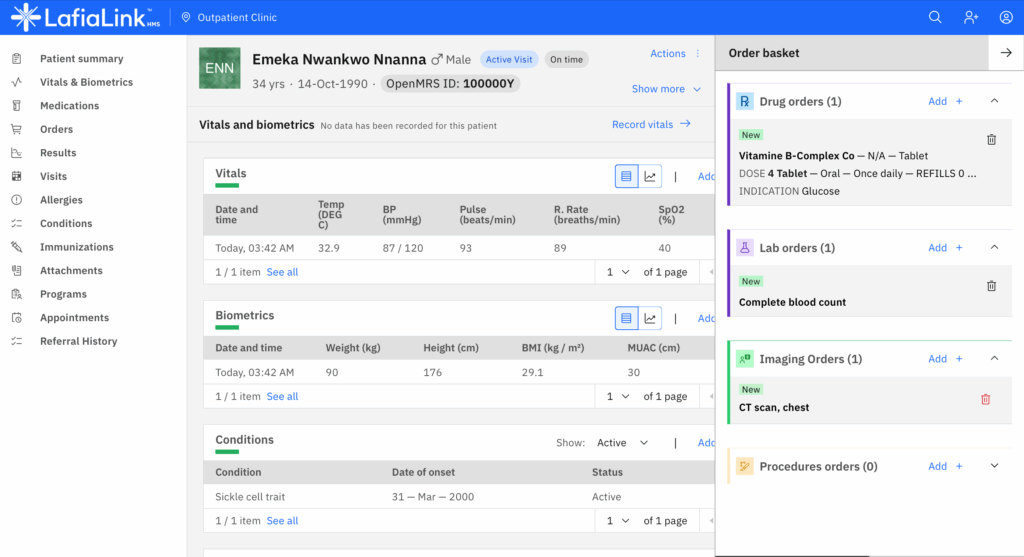
The HMS module brings the full clinical and operational workflow of a hospital onto a single, integrated interface. Patient registration, outpatient and inpatient management, ward management, pharmacy, laboratory, radiology, billing, and discharge — all flowing through one system with a shared patient record at the centre. No reconciling data between different applications. No duplication. No gaps in the patient’s story.
3. LafiaLinkERP — Enterprise Resource Planning
Healthcare is also a business. LafiaLink’s ERP module addresses that reality with financial management, HR, payroll, procurement, and inventory tools built specifically for hospital operations. Facilities that previously managed their finances in spreadsheets and their clinical data in a separate system now have a single source of truth across both domains. Revenue leakage, one of the most stubborn problems in private Nigerian healthcare, becomes far easier to detect and control.
4. LafiaLinkPC & Infrastructure — Hardware Built for Context
This is where LafiaLink™ most clearly parts ways with every other vendor in the market. Recognising that software is only as reliable as the hardware it runs on, Axtute designed the LafiaLinkPC — a low-power, high-performance endpoint device purpose-built for Nigerian clinical environments. Paired with solar power solutions and dual internet connectivity, LafiaLink ensures the platform keeps running even when the national grid and primary internet provider both fail simultaneously. This is not a theoretical failsafe. For many facilities, it is a daily operating requirement.
5. Public Health & Analytics
LafiaLink extends beyond the walls of individual facilities. The platform includes population health management tools, disease surveillance integration with SORMAS (the Surveillance Outbreak Response Management and Analysis System), and a data and analytics layer that gives facility administrators and public health stakeholders visibility into trends that individual patient records alone cannot surface.

The Vendor-Multiplicity Problem — Solved
Ask any hospital administrator managing a typical mix of healthcare technology and they will describe something that looks less like a platform and more like a collection of compromises. An EMR from one vendor. Accounting software from another. A separate pharmacy system. A standalone HR tool. Each with its own licensing, its own support contract, its own upgrade cycle — and its own data format that doesn’t quite speak to the others.
LafiaLink™ collapses this complexity into a single vendor relationship. One deployment. One support contact. One integrated data environment. The operational and financial benefits are significant, but perhaps more important is the clinical benefit: a patient record that is genuinely complete, from registration through discharge, across pharmacy, lab, ward, and billing, accessible to every authorised clinician in real time.
Designed for Africa, Not Adapted for It
There is a meaningful difference between a product built for a specific context and a product adapted for it. Most health technology deployed in Nigeria falls into the second category — software designed for stable Western infrastructure, then retrofitted with offline modes and localisation patches.
LafiaLink belongs to the first. Every design decision — from the low-power hardware to the solar integration to the locally delivered training, reflects a development philosophy grounded in Africa’s actual healthcare environment, not an idealised version of it.
The platform is built to operate reliably in a rural clinic in Akwa Ibom with the same fidelity as it does in a private specialist hospital in Lagos.
That grounding matters enormously for adoption. Technology that fights its environment eventually loses. Technology designed with its environment in mind has a genuine chance of becoming part of how care is delivered — and staying that way.
What ‘Complete’ Actually Means for Patients
The value proposition of LafiaLink™ is usually discussed in operational terms — efficiency, integration, uptime, cost reduction. These matter. But they are ultimately means to an end that the healthcare sector exists to serve: better patient outcomes.
When a platform is truly complete, the effects are felt at the bedside:
- A doctor reviewing a returning patient has access to their full history — not just what was recorded in the EMR, but lab results, prescriptions, and billing notes — without calling three departments.
- A pharmacist can see the prescribing doctor’s notes and flag interactions without the patient acting as the messenger between departments.
- A nurse on night shift can see which medications have been administered and which are outstanding — even if the system brief hours earlier was running on solar backup.
- An administrator generating a month-end report isn’t reconciling numbers from four different systems — everything is already in one place.
These are not aspirational features. They are what becomes possible when the technology serving a hospital actually works — reliably, consistently, and as a connected whole.
The Sustainability Argument
Digital health adoption in African hospitals has a history of short cycles: a system is implemented, staff are trained, and eighteen months later the platform is abandoned, often because local support was unavailable, because infrastructure made it unreliable, or because the costs of maintaining multiple vendor relationships became unmanageable.
LafiaLink is structured to break that cycle. The solar and connectivity infrastructure means the platform keeps running regardless of external conditions.
The local training model means facilities build internal capacity rather than dependency. And the single-vendor model means that when something needs fixing, there is one party responsible — and that party is reachable.
Sustainable digital transformation in healthcare does not happen through bold deployments followed by gradual abandonment. It happens when the technology is reliable enough, supported enough, and integrated enough that staff choose to use it — every day, without workarounds.

A Platform for the Continent’s Healthcare Future
Africa’s healthcare infrastructure challenge is significant. But it is not permanent. Across Nigeria and the broader continent, a generation of hospitals, clinics, and health systems are making decisions right now about which digital platforms will define how they deliver care for the next decade.
LafiaLink™ makes a compelling case for being the answer those facilities have been waiting for, not because it does one thing extraordinarily well, but because it does everything together.
EMR, HMS, ERP, hardware, power, connectivity, training, and support: integrated, African-built, and designed from the ground up for the real conditions under which healthcare happens here.
Frequently Asked Questions
What is LafiaLink™ and who makes it?
LafiaLink™ is a vertically integrated healthcare technology platform developed by Axtute Digital Health, a Lagos-based digital health company. The platform combines an electronic medical records system (EMR), hospital management system (HMS), enterprise resource planning (ERP), custom hardware, solar power infrastructure, and internet connectivity into a single, unified solution designed specifically for hospitals and clinics across Nigeria and Africa.
What types of hospitals is LafiaLink™ designed for?
LafiaLink™ is built for a wide range of healthcare facilities — from private specialist hospitals in Lagos and Abuja to mid-size general hospitals in secondary cities, and even rural or semi-urban clinics operating with limited infrastructure. Because it includes its own power and connectivity solutions, it functions reliably in environments where conventional healthcare software would fail.
How does LafiaLink™ handle power outages?
LafiaLink™ is paired with solar power systems and low-energy LafiaLinkPC hardware, meaning the platform continues to operate during grid outages without requiring a generator. Clinical and administrative data remain accessible, patient records stay live, and workflows are uninterrupted — even during extended power cuts that would render conventional cloud-based systems completely inaccessible.
Does LafiaLink™ work without reliable internet?
Yes. The platform is designed with dual internet connectivity and is engineered to function in low-bandwidth and intermittent-connectivity environments. Unlike cloud-only EMR platforms that become non-functional when internet access drops, LafiaLink™ maintains core clinical and administrative operations offline and syncs when connectivity is restored.
What is the difference between LafiaLinkCore, LafiaLinkHMS, and LafiaLinkERP?
LafiaLinkCore is the security and administration backbone — handling facility verification, staff credentialing, role-based access control, and regulatory compliance. LafiaLinkHMS is the hospital management system covering patient registration, wards, pharmacy, laboratory, radiology, and billing. LafiaLinkERP handles the business side of hospital operations: finance, HR, payroll, procurement, and inventory. All three work together as one integrated platform, not separate tools.
How long does it take to deploy LafiaLink™?
Deployment timelines vary based on facility size and complexity, but Axtute Digital Health provides end-to-end implementation support including hardware installation, staff training, and system configuration. Hospitals can contact the Axtute team via axtute.com/request-demo to discuss a deployment plan tailored to their facility.
Is LafiaLink™ compliant with Nigerian health regulations?
Yes. LafiaLinkCore includes built-in compliance frameworks, automated regulatory reporting, and policy enforcement tools designed to align with Nigeria’s healthcare governance requirements. The platform is built with audit-readiness in mind, maintaining complete logs of all system activity.
In a market full of tools that solve parts of the problem, LafiaLink™ may be the first platform that solves all of it.
