Top 5 Hospital Management Software in Nigeria
Hospital Management Software (HMS), sometimes called Hospital Management Information Systems (HMIS), are comprehensive digital platforms that centralise clinical, administrative, and financial operations for healthcare facilities.
Nigerian hospitals are under pressure. Growing patient loads, outdated paper-based systems, fragmented records, and the constant battle against power failures and poor connectivity have pushed healthcare administrators to their limits. The good news? The healthtech revolution is here, and it is built for Nigeria.
A good HMS does not just help hospitals go paperless. It cuts billing errors, reduces drug stock-outs, speeds up patient turnaround, and gives administrators real-time visibility into how their facility is performing.
But here is the catch: not every HMS was built for the Nigerian context. Generic, imported solutions often assume perfect internet connectivity, uninterrupted electricity, and IT-literate staff, none of which can be taken for granted across Nigerian health facilities.
The best HMS for Nigerian hospitals is one that understands your environment and was designed to work within it.
Whether you run a private clinic in Lagos, a specialist hospital in Abuja, a diagnostic centre in Port Harcourt, or a multi-branch healthcare network, this guide breaks down the top five hospital management software solutions operating in Nigeria today, starting with the most innovative homegrown option in the market.
1. LafiaLink by Axtute Digital Health
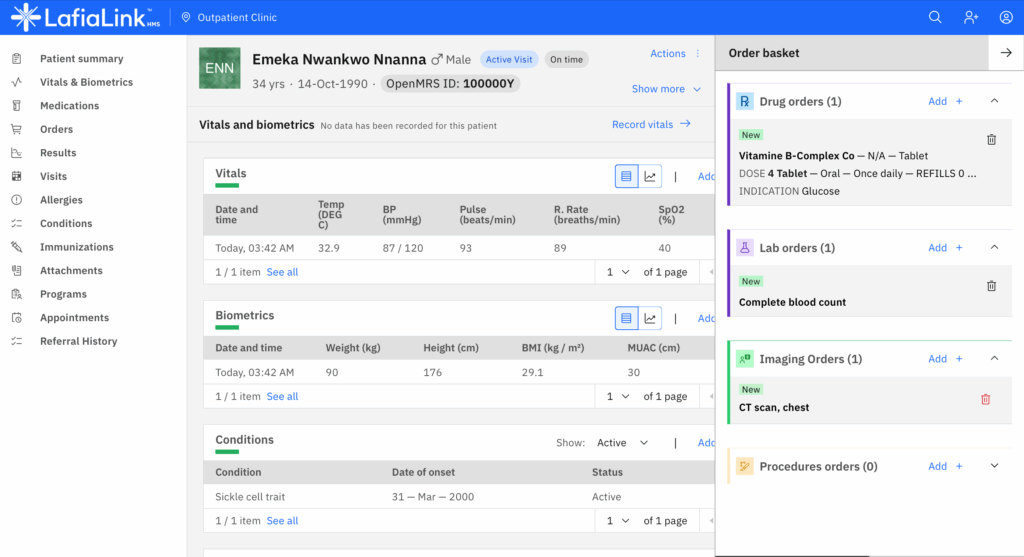
Best for: Healthcare facilities that need a complete, infrastructure-inclusive HMS built specifically for Africa’s healthcare realities.
If there is one HMS that was built from the ground up for Nigerian hospitals, not adapted, localised, or retooled from a foreign product, it is LafiaLink.
Developed by Axtute Digital Health, a Lagos-based digital health company, LafiaLink is not just software. It is described as the first truly complete, vertically integrated healthcare technology platform designed specifically for resource-constrained environments.
Most HMS solutions stop at software. LafiaLink goes further. Recognising that unreliable electricity, limited internet connectivity, and inadequate IT infrastructure are not edge cases in Nigeria, they are the norm, Axtute has built an entire ecosystem around LafiaLink.
The platform bundles custom hardware, redundant internet connectivity, solar power solutions, local training, and ongoing technical support into one unified offering.
That is a fundamentally different approach to healthcare digitisation, and it addresses the single biggest reason HMS implementations fail in Nigeria: the assumption that infrastructure already exists.
What Makes LafiaLink Stand Out
LafiaLink operates as a suite of integrated modules:
LafiaLinkHMS — a complete Electronic Medical Records (EMR) system that manages patient registration, clinical documentation, outpatient and inpatient workflows, lab orders, pharmacy prescriptions, and analytics.
The system supports voice-to-text consultation notes (offline-capable), clinical decision support, drug interaction checking, and customisable templates for common conditions.
LafiaLinkCore — the foundational administrative layer that handles patient identification, insurance management, appointment scheduling, and facility administration across the entire platform.
LafiaLinkERP — a financial and operational management module that integrates with clinical data to support billing, procurement, inventory, payroll, and reporting.
LafiaLinkPC — a custom, low-power, high-performance hardware unit purpose-built to run LafiaLink in environments with irregular electricity supply, eliminating the need for expensive imported hardware.
Population Health and Disease Surveillance — including integration with SORMAS, Nigeria’s official disease surveillance platform. This is critical for hospitals engaged in public health reporting.
Patient Portal — a dedicated interface that lets patients access their health records, manage appointments, and interact with their care providers digitally.
The offline capability of LafiaLink deserves special emphasis. In a country where internet connectivity drops without warning, an HMS that cannot function offline is an HMS that will fail your patients at the worst moments.
LafiaLink is built to continue working without internet, syncing data when connectivity is restored. This alone sets it apart from many cloud-first competitors.
Key Benefits
Fully offline-capable — no internet, no problem
Infrastructure-bundled: hardware, solar power, and connectivity included
Purpose-built for African healthcare workflows, not adapted from Western models
Scalable from small clinics to large multi-specialty hospitals
SORMAS integration for disease surveillance and public health reporting
Single partner for the entire technology transformation — no vendor juggling
“LafiaLink succeeds because we provide everything needed to transform healthcare delivery — from software to solar power to support.” — Axtute Digital Health
Developer: Axtute Digital Health Ltd., Lagos, Nigeria
Best For: Hospitals and clinics in Nigeria seeking a complete, infrastructure-inclusive digital health transformation
Deployment: Cloud and on-premise hybrid with offline capability
Pricing: Custom, based on facility size and modules
Website: axtute.com
2. Helium Health (HeliumOS)
Best for: Mid-to-large healthcare facilities seeking a widely-adopted, venture-backed EMR/HMIS with integrated fintech capabilities.

Helium Health is arguably the most well-known Nigerian healthtech brand. Founded in 2016 by Adegoke Olubusi, Tito Ovia, and Dimeji Sofowora, Helium Health set out to build the technology backbone for healthcare in Africa.
Today, it operates as the largest provider of full-service health technology solutions for healthcare stakeholders in emerging markets.
The company’s flagship product is HeliumOS, a SaaS-based EMR and Hospital Management Information System (HMIS) that serves as the operating system for care provision.
HeliumOS has been deployed in over 1,000 healthcare facilities across six African markets and two Gulf Cooperation Council (GCC) markets. The platform has supported over 10,000 health workers and more than one million patients, making it the widest-reaching EMR platform in West Africa.
The Helium Ecosystem
What separates Helium Health from a single-product HMS is its suite of interconnected solutions:
HeliumOS — the core EMR and HMIS platform covering patient management, clinical documentation, lab management, pharmacy, billing, and reporting.
HeliumDoc — a telemedicine and appointment booking platform that enables remote consultations and provider-patient interaction. HeliumDoc has been expanded into an AI-powered preventive health tool, screening young Nigerians for HIV, TB, and diabetes risk.
HeliumCredit — a healthcare-specific digital lending product that has extended over $3.5 million in collateral-free loans to healthcare facilities in Nigeria. Loan applications receive responses within 48 hours, with limits between ₦500,000 and ₦10 million.
HeliumWallet — a payment and billing solution that simplifies financial workflows within health facilities.
Helium Health raised a $30 million Series B funding round led by AXA Investment Managers, with participation from Tencent, Global Ventures, and other international investors. This level of institutional backing provides strong confidence in the platform’s long-term viability and continued development.
For hospitals seeking a solution with a track record at scale, deep public health partnerships, and an evolving AI layer, HeliumOS is a serious contender. The HeliumCredit product is also uniquely valuable for under-resourced facilities looking to access equipment financing without traditional bank collateral.
Key Benefits
Widest-reaching EMR platform in West Africa by patient volume
Integrated healthcare financing through HeliumCredit
Telemedicine and AI-powered preventive health via HeliumDoc
Strong government and NGO partnerships across Nigeria
Active in 6 African markets — strong support infrastructure
Developer: Helium Health, Lagos, Nigeria
Best For: Mid-to-large hospitals and clinic networks needing a battle-tested, feature-rich HMIS with fintech add-ons
Deployment: Cloud (SaaS)
Pricing: Custom, based on facility size and modules
Website: heliumhealth.com
3. eRapha by Lagetronix
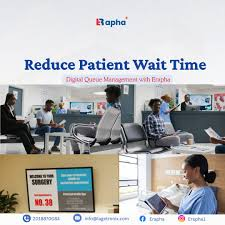
Best for: Nigerian hospitals seeking an AI-enabled, Microsoft Azure-powered HMS with deep ERP integration.
eRapha is a homegrown hospital management system developed by Lagetronix, a Lagos-based IT and software solutions company with roots going back to 1993.
What sets eRapha apart is its foundation on Microsoft Azure and its tight integration with enterprise resource planning (ERP) tools — making it one of the most enterprise-grade HMS options available in Nigeria.
Designed to help hospitals, doctors, nurses, and other healthcare staff make their work paperless, eRapha covers the full spectrum of hospital workflows. It is cloud-based but can also be deployed on-premise or as a hybrid, a flexibility that matters enormously in Nigerian healthcare environments where connectivity varies.
Core Features
Electronic Health Records (EHR) and Electronic Medical Records (EMR) with secure, centralised patient data management
Appointment scheduling and patient management with comprehensive medical history, allergy tracking, and insurance information
Pharmacy management including prescription processing, dispensing, and inventory control
Laboratory management with electronic test ordering, sample tracking, and results reporting
Billing module with built-in support for Health Maintenance Organisations (HMOs), handling both insured and out-of-pocket patients
Telemedicine integration with online consultation, report sharing, and simultaneous prescriptions during video calls
AI-powered case notes and user-defined dashboards and analytics
ERP integration that connects clinical data to financial and operational management systems
Multi-branch support for hospital networks managing multiple locations from a centralised platform
HIPAA-compliant security architecture with AES-encryption to protect patient data
eRapha’s use of Microsoft Azure infrastructure brings enterprise-grade reliability, global security standards, and regular platform updates — backed by the credibility of Microsoft’s cloud ecosystem.
The system is listed on Microsoft AppSource, which speaks to its alignment with enterprise standards. Lagetronix also offers 24/7 customer support, a significant operational advantage for facilities that cannot afford system downtime.
eRapha is particularly well-suited for larger facilities with complex billing environments, HMO-heavy patient mixes, or facilities already running on Microsoft’s ecosystem.
Key Benefits
Built on Microsoft Azure — enterprise-grade reliability and security
AI-enabled clinical documentation and analytics
Deep HMO billing integration — critical for Nigerian private hospitals
Telemedicine module built into the core platform
Flexible deployment: cloud, on-premise, or hybrid
24/7 technical support
Developer: Lagetronix, Lagos, Nigeria
Best For: Medium-to-large hospitals with complex billing needs and HMO patient volumes
Deployment: Cloud (Azure SaaS/PaaS), on-premise, or hybrid
Pricing: Custom, based on facility size, modules, and user count
Website: lagetronix.com/e-rapha
4. MediTrust HMS by Trust Care Solutions
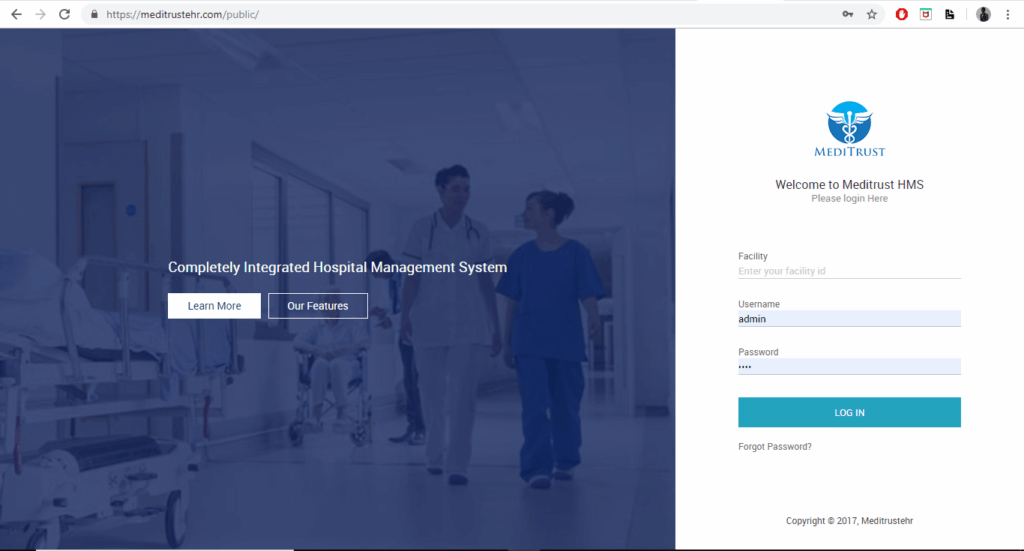
Best for: Healthcare facilities seeking a cloud-based, highly customisable HMS with a strong public health infrastructure focus.
MediTrust HMS is developed by Trust Care Solutions, a Nigerian healthcare IT company focused on delivering Health Information Technology as a Service (HITaaS).
The platform is designed to handle the workflows of any hospital — from the smallest clinic to the largest tertiary hospital — making it one of the more versatile options available to Nigerian healthcare administrators.
The cloud-based architecture means that all practitioners and patients need is an internet connection and a device, whether a laptop, tablet, or smartphone, to access the platform.
This lean infrastructure requirement is positioned as a cost-saving measure for both government and private hospital systems that want to avoid heavy capital expenditure on IT infrastructure.
Core Features
Complete hospital administration covering OPD, IPD, doctor availability, and departmental workflows from a single login
Electronic prescriptions delivered directly to the pharmacy unit before the patient arrives — reducing wait times and improving dispensing accuracy
E-pharmacy module with drug-drug interaction detection, drug-food reaction alerts, allergy tracking, and inventory management
Laboratory management with electronic test ordering and results delivery to the EMR
Patient portal for direct communication between patients and doctors across referrals — even when transferring between facilities or across states
NHIS (National Health Insurance Scheme) management module — a critical capability for facilities servicing insured patient populations
Voucher/prepaid system for managing patient payments, modelled on the prepaid telecom system — a clever localisation for Nigerian patients
Drug and consumable procurement tracking from purchase to final consumer — useful for government hospital networks managing supply chains
Revenue transparency tools that allow hospital administrators to track departmental earnings in real time
One of MediTrust’s distinguishing features is its focus on the referral ecosystem. When a patient is referred from one hospital to another, or moves between states, their care can be continued seamlessly via the patient portal.
In a country where continuity of care across facilities is a persistent challenge, this is a meaningful capability.
MediTrust HMS also offers specific modules for managing the National Health Insurance Scheme (NHIS), making it well-suited for government-owned facilities and private hospitals managing large HMO and NHIS-enrolled patient populations.
Key Benefits
NHIS management built into the platform — essential for public health facilities
Voucher/prepaid billing system designed for the Nigerian payment context
Strong referral and cross-facility care continuity features
Cloud-based — no heavy IT infrastructure required
Highly customisable to individual hospital workflows
Developer: Trust Care Solutions, Nigeria
Best For: Government-affiliated hospitals, NHIS-heavy facilities, and hospitals focused on inter-facility care continuity
Deployment: Cloud-based (HITaaS)
Pricing: Customised based on hospital size and modules
Website: trustcaresolutions.com
5. Adroit eHospital Systems (via BT Technologies)
Best for: Nigerian healthcare facilities seeking an internationally developed, locally deployed HMS with a strong on-ground partner.
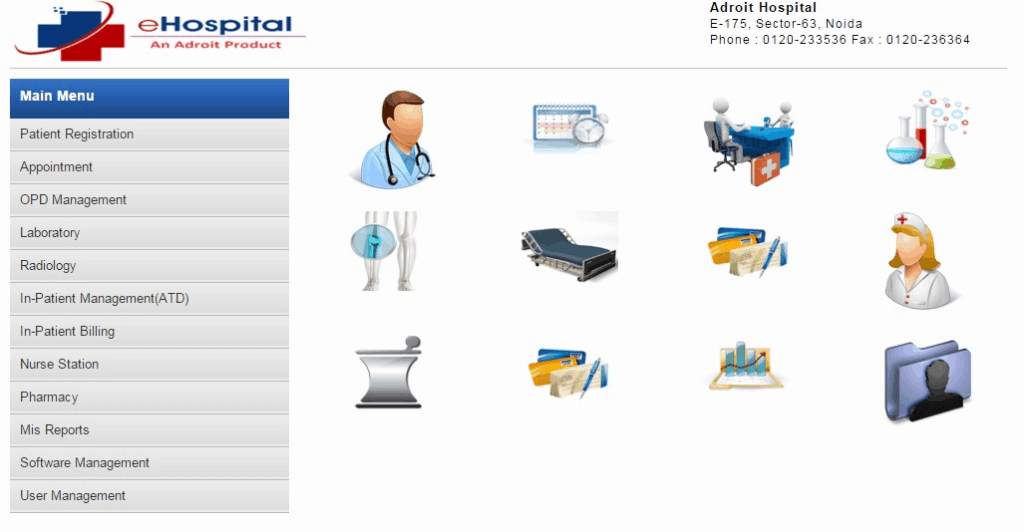
Adroit eHospital Systems is an internationally recognised hospital management solution deployed across Nigeria through a strategic partnership with BT Technologies Ltd (BTT) — a leading IT and telecommunications infrastructure company that has operated in Nigeria since 2001.
The Adroit-BTT collaboration combines world-class healthcare software with deep local technology expertise, making it one of the most established international-origin HMS solutions operating in the Nigerian market.
The eHospital system is designed to serve healthcare providers of all sizes — from individual clinics to large multi-specialty hospitals — and covers the full range of operational, clinical, and administrative needs.
Core Features
Comprehensive patient management covering appointments, medical records, treatment plans, and follow-up care
Outpatient (OPD) and inpatient (IPD) management including bed allocation, admission, discharge, and transfer workflows
Pharmacy management with real-time inventory tracking, prescription processing, and dispensing
Laboratory management with test ordering, results tracking, and reporting
Radiology module — a differentiator among Nigerian HMS offerings
Billing and financial management with support for both self-pay and insured patients
Inventory management for medical consumables and supplies
Administrative workflow automation to reduce paperwork and manual processes
Enhanced data security with patient record protection and access control
The dual deployment model — on-premise or cloud — gives hospitals flexibility depending on their infrastructure situation. Facilities in locations with reliable power and connectivity can take advantage of the cloud-based version, while those in more challenging environments can opt for on-premise deployment.
The BTT partnership is significant. Having a locally embedded technology partner with over two decades of Nigeria-specific IT infrastructure experience means that implementation, training, and ongoing support are grounded in an understanding of the Nigerian operating environment.
This localisation layer is often the difference between an HMS that works on paper and one that actually delivers results on the ground.
Key Benefits
Proven international software with strong local implementation support
Dual deployment: cloud and on-premise
Radiology module included — uncommon in lower-tier HMS offerings
Trusted by prominent healthcare providers across Nigeria
Long-standing local partner (BTT) with deep Nigeria-specific IT expertise
Developer: Adroit Infosystems (via BT Technologies Ltd), Nigeria
Best For: Hospitals seeking an internationally developed platform with strong local implementation support
Deployment: Cloud and on-premise
Pricing: Custom, based on modules and facility size
Website: adroitinfosystems.com
How to Choose the Right HMS for Your Facility
There is no universally “best” HMS — only the best fit for your specific context. Here are the key decision factors to guide your choice:
1. Infrastructure Reality
If your facility operates in an area with frequent power outages, poor connectivity, or limited IT support staff, you need an HMS that was built for those conditions, not one that tolerates them. LafiaLink is currently the only Nigerian HMS that bundles solar power, hardware, and redundant connectivity as part of its core offering.
2. Scale and Complexity
Small-to-medium clinics have different needs from large teaching hospitals or multi-branch networks. Helium Health and Adroit eHospital have strong track records at scale. LafiaLink and eRapha are both designed to scale from small clinics upward.
3. Billing and HMO Requirements
For facilities managing significant HMO or NHIS-enrolled patient volumes, HMO billing integration is non-negotiable. eRapha and MediTrust HMS both offer strong HMO-specific billing capabilities.
4. Public Health Reporting
Government hospitals or facilities engaged in public health programmes need HMS platforms with disease surveillance and regulatory reporting capabilities. LafiaLink’s SORMAS integration and Helium Health’s government partnerships make them standout options here.
5. Financing Access
If your facility needs capital to fund technology adoption or equipment purchases, Helium Health’s HeliumCredit product offers a unique embedded lending option that no other HMS on this list provides.
Nigerian healthcare is at an inflection point. The facilities that digitise now, with the right systems, will define the next generation of healthcare delivery in this country.
The five platforms profiled in this guide represent the best of what is available to Nigerian hospital administrators today.
LafiaLink stands apart as the only solution that has truly rethought healthcare digitisation from the infrastructure layer up, addressing the exact challenges that cause other systems to fail in Nigerian environments.
Helium Health brings scale, institutional credibility, and fintech innovation. eRapha delivers enterprise-grade reliability through Microsoft Azure.
MediTrust HMS leads on NHIS integration and care continuity. And Adroit eHospital brings internationally tested software to Nigerian soil through a capable local partner.
Whichever platform you choose, the most important step is to request a demo, involve your clinical and administrative teams in the evaluation, and insist on seeing the system work in conditions that reflect your actual operating environment, not ideal ones.
The right HMS does not just manage your hospital.
